July 17, 2022 (The New Atlas) - Evidence is emerging that at least some segments of the ongoing protests in Sri Lanka are funded and backed by the US, serving US interests. A “digital strategist” given credit by the Western media for the successful toppling of the Sri Lankan government was a “volunteer” at a US National Endowment for Democracy-funded “election” organization.

Showing posts with label sri Lanka. Show all posts
Showing posts with label sri Lanka. Show all posts
US Fingerprints Found Behind Sri Lanka Unrest

Debt Traps & Terrorism: The Roots of Sri Lanka’s Crisis
July 17, 2022 (Brian Berletic - New Eastern Outlook) - The island nation of Sri Lanka, located south-southeast of India in the Indian Ocean has suffered economic and now political chaos that has grabbed international headlines.
The Western media has floated narratives ranging from “debt trap diplomacy” perpetrated by China and its Belt and Road Initiative to food shortages spurred by Russia’s “blockade” of the Black Sea. None of this is true, and even within the pages of Western newspapers, this truth is eventually admitted.
Sri Lanka is a nation that has suffered political and economic turmoil since gaining independence from the British Empire in 1948. Like many former British colonies, Sri Lanka inherited deep ethnic and religious divides purposefully perpetuated by the UK and then the US in a bid to maintain Western influence over the ostensibly independent South Asian country. The worst manifestation of this was the Sri Lankan Civil War stretching from 1983 to 2009.
For 26 years the nation faced a taxing armed conflict against the Liberation Tigers of Tamil Eelam (LTTE) composed of Indian Tamils. While there existed genuine ethnic tensions in Sri Lanka, the 26 year long conflict resulted from clandestine support from the US and likely India, both in terms of funding and arms, as well as oblique political support.
US diplomatic cables now publicly available thanks to Wikileaks show how the US embassy in Colombo and representatives of the United Nations’ Office of the High Commissioner for Human Rights (OHCHR) sought to tie the hands of the Sri Lankan government in eliminating the LTTE and how OHCHR staff met with LTTE members and with Washington’s backing, worked with them to form parallel institutions helping expand the LTTE’s political power and thus prolong the conflict.
Other cables reveal how Washington was aware of LTTE fundraising within the United States but took no measures whatsoever to address it.
The Western media has floated narratives ranging from “debt trap diplomacy” perpetrated by China and its Belt and Road Initiative to food shortages spurred by Russia’s “blockade” of the Black Sea. None of this is true, and even within the pages of Western newspapers, this truth is eventually admitted.
Sri Lanka’s History of Crisis
Sri Lanka is a nation that has suffered political and economic turmoil since gaining independence from the British Empire in 1948. Like many former British colonies, Sri Lanka inherited deep ethnic and religious divides purposefully perpetuated by the UK and then the US in a bid to maintain Western influence over the ostensibly independent South Asian country. The worst manifestation of this was the Sri Lankan Civil War stretching from 1983 to 2009.
For 26 years the nation faced a taxing armed conflict against the Liberation Tigers of Tamil Eelam (LTTE) composed of Indian Tamils. While there existed genuine ethnic tensions in Sri Lanka, the 26 year long conflict resulted from clandestine support from the US and likely India, both in terms of funding and arms, as well as oblique political support.
US diplomatic cables now publicly available thanks to Wikileaks show how the US embassy in Colombo and representatives of the United Nations’ Office of the High Commissioner for Human Rights (OHCHR) sought to tie the hands of the Sri Lankan government in eliminating the LTTE and how OHCHR staff met with LTTE members and with Washington’s backing, worked with them to form parallel institutions helping expand the LTTE’s political power and thus prolong the conflict.
Other cables reveal how Washington was aware of LTTE fundraising within the United States but took no measures whatsoever to address it.
Sri Lanka: US-Saudi Terror Behind Deadly Blasts
April 29, 2019 (Tony Cartalucci - NEO) - As predicted, the Sri Lankan Easter Day blasts which killed hundreds and injured hundreds more - have been connected to the so-called "Islamic State" (ISIS).

US Ambassador to Sri Lanka - Alaina Teplitz - would openly claim foreign groups were most likely behind the attacks. Reuters in an article titled, "Foreign groups likely behind Sri Lanka attacks, U.S. ambassador says," would report:
At face value - devastating and disruptive terrorist attacks visited upon Sri Lanka - a nation that has recently and decisively pivoted from West to East and is now a major partner of Beijing's One Belt, One Road (OBOR) initiative - is suspiciously coincidental.
Examining the West's decades of using terrorism - particularly terrorism fuelled by Saudi Wahhabism - and the inception of ISIS itself - leaves Washington and its partners as the prime suspects behind Sri Lanka's tragic terrorist attack - with its motivation strikingly similar to what prompted the US-Saudi aided rise and use of the Muslim Brotherhood and Al Qaeda throughout the Cold War.
DIA Admitted West Sought "Salafist Principality" in Eastern Syria
When US-engineered regime change stalled in Syria between 2011-2012, it became clear more drastic and open measures would be required. This included not only the Western media mobilizing a massive propaganda campaign to account for the increasingly overt role terrorist organizations were playing among supposed "moderate rebel" formations - but also in the sudden appearance, rise, and overwhelming force of the "Islamic State."
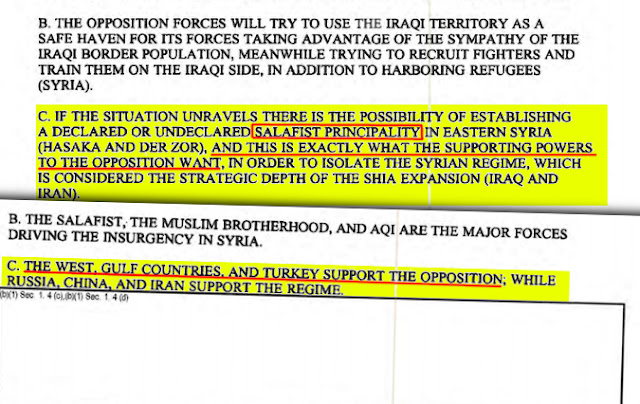
It was in a leaked 2012 US Defense Intelligence Agency (DIA) memo (PDF) - however - that revealed it was the US and its allies' deliberate intent to create what it called a "Salafist principality" in eastern Syria. The memo would explicitly state that (emphasis added):
Since then, ISIS has been used as a convenient and even predictable element amid Washington's various gambits as it struggles globally to maintain its unipolar world order.

US Ambassador to Sri Lanka - Alaina Teplitz - would openly claim foreign groups were most likely behind the attacks. Reuters in an article titled, "Foreign groups likely behind Sri Lanka attacks, U.S. ambassador says," would report:
The scale and sophistication of the Easter Sunday attacks on churches and hotels in Sri Lanka suggested the involvement of an external group such as Islamic State, the U.S. ambassador said on Wednesday as the death toll jumped to 359.ISIS itself would also later claim responsibility for the attacks. The Washington Post in an article titled, "Sri Lankan Easter bombings, claimed by ISIS, show the group maintains influence even though its caliphate is gone," would claim:
On Tuesday, video emerged of the suspected ringleader of the attacks and seven followers, their faces obscured by scarves, swearing allegiance to the Islamic State and its leader, Abu Bakr al-Baghdadi. The Islamic State also issued a formal communique asserting responsibility for the attacks, which it said targeted Christians and “coalition countries.”Absent from US diplomatic statements and Western media reports is any mention of ISIS' inception, its state sponsors, and even admissions by Western intelligence agencies themselves of Washington and its allies' role in the terrorist organization's rise.
At face value - devastating and disruptive terrorist attacks visited upon Sri Lanka - a nation that has recently and decisively pivoted from West to East and is now a major partner of Beijing's One Belt, One Road (OBOR) initiative - is suspiciously coincidental.
Examining the West's decades of using terrorism - particularly terrorism fuelled by Saudi Wahhabism - and the inception of ISIS itself - leaves Washington and its partners as the prime suspects behind Sri Lanka's tragic terrorist attack - with its motivation strikingly similar to what prompted the US-Saudi aided rise and use of the Muslim Brotherhood and Al Qaeda throughout the Cold War.
DIA Admitted West Sought "Salafist Principality" in Eastern Syria
When US-engineered regime change stalled in Syria between 2011-2012, it became clear more drastic and open measures would be required. This included not only the Western media mobilizing a massive propaganda campaign to account for the increasingly overt role terrorist organizations were playing among supposed "moderate rebel" formations - but also in the sudden appearance, rise, and overwhelming force of the "Islamic State."

It was in a leaked 2012 US Defense Intelligence Agency (DIA) memo (PDF) - however - that revealed it was the US and its allies' deliberate intent to create what it called a "Salafist principality" in eastern Syria. The memo would explicitly state that (emphasis added):
If the situation unravels there is the possibility of establishing a declared or undeclared Salafist principality in eastern Syria (Hasaka and Der Zor), and this is exactly what the supporting powers to the opposition want, in order to isolate the Syrian regime, which is considered the strategic depth of the Shia expansion (Iraq and Iran).On clarifying who these supporting powers were, the DIA memo would state:
The West, Gulf countries, and Turkey support the opposition; while Russia, China, and Iran support the regime.The "Salafist" (Islamic) "principality" (State) would indeed be created precisely in eastern Syria as US policymakers and their allies had set out to do. It would be branded as the "Islamic State" and be used first to wage a more muscular proxy war against Damascus, and when that failed, to invite US military forces to intervene in the conflict directly.
Since then, ISIS has been used as a convenient and even predictable element amid Washington's various gambits as it struggles globally to maintain its unipolar world order.
Sri Lanka Blasts: Terrorism Targets Another Chinese Ally
April 26, 2019 (Tony Cartalucci - NEO) - The recent, tragic Easter attack in the South Asian state of Sri Lanka - killing and injuring hundreds - follows a now unfortunately all too familiar formula.

The New York Times has reported in its article, "What We Know and Don’t Know About the Sri Lanka Attacks," that:
Countering OBOR: Divide and Destroy
Sri Lanka has recently and decisively pivoted toward Beijing as a major partner of the One Belt, One Road (OBOR) initiative. This is despite Washington's best efforts to prevent it from doing so.
Consequently, extremists fuelled by Washington's "clash of civilizations" have helped set the stage for growing violence between Sir Lanka's majority Buddhists and its minority Muslim communities. The resulting violence serves as a medium for US coercion, destabilization, and intervention aimed at undermining Sri Lanka's unity as a nation, and thus its viability as a partner for China.
A nearly identical ploy has been used in nearby Myanmar where US-backed Buddhist extremists battle against US-Saudi-Qatari backed extremism rising from the ranks of the nation's Muslim Rohingya minority.
The resulting violence and growing humanitarian crisis - without coincidence - is unfolding in Myanmar's Rakhine state - precisely where China is attempting to build another leg of its region-spanning OBOR initiative.
Sri Lanka has signed on to OBOR in a big way, with major rail, port, airport, and highway projects all moving forward with Beijing's support. Sri Lanka is also considered by Western policymakers as one of several among China's strategic "String of Pearls," strong points where China can secure maritime routes through waters traditionally dominated by the United States.

These projects are derided across the Western media with headlines like the New York Times' article, "How China Got Sri Lanka to Cough Up a Port" and France24's article, "In Sri Lanka, the new Chinese Silk Road is a disappointment" - characterizing Washington's growing opposition to China's expanding influence across Asia - a region Washington has long presumed primacy over.
Washington's ability to compete with China regarding regional development is nonexistent. Instead, the US has tried to tempt nations like Sri Lanka with military aid.
AFP in an article titled, "US gives Sri Lankan military US$39 million, countering China’s investments in strategic island," would claim:
It is obvious that "military aid" can in no way compete with massive investments by China aimed at spurring national development through tangible infrastructure projects.
America's inability to compete openly and on equal economic footing has given way to political interference and even the use of violence.
Sri Lanka's Crisis Linked to US-Driven Crisis in Myanmar
In Myanmar, the US is documented to have supported ethnic violence for years. The US all but installed current "State Counsellor" Aung San Suu Kyi into power along with her political party - the National League for Democracy (NLD) lined top to bottom with US State Department-funded "activists."

The New York Times has reported in its article, "What We Know and Don’t Know About the Sri Lanka Attacks," that:
The authorities in Sri Lanka said a little-known radical Islamist group, the National Thowheeth Jama’ath, carried out the attacks, with help from international militants.It is also reported that these extremists received assistance for the large-scale attack from foreign sponsors. The attack has put Sri Lanka on the map for many in the general public for the first time - but for all the wrong reasons.
Countering OBOR: Divide and Destroy
Sri Lanka has recently and decisively pivoted toward Beijing as a major partner of the One Belt, One Road (OBOR) initiative. This is despite Washington's best efforts to prevent it from doing so.
Consequently, extremists fuelled by Washington's "clash of civilizations" have helped set the stage for growing violence between Sir Lanka's majority Buddhists and its minority Muslim communities. The resulting violence serves as a medium for US coercion, destabilization, and intervention aimed at undermining Sri Lanka's unity as a nation, and thus its viability as a partner for China.
A nearly identical ploy has been used in nearby Myanmar where US-backed Buddhist extremists battle against US-Saudi-Qatari backed extremism rising from the ranks of the nation's Muslim Rohingya minority.
The resulting violence and growing humanitarian crisis - without coincidence - is unfolding in Myanmar's Rakhine state - precisely where China is attempting to build another leg of its region-spanning OBOR initiative.
Sri Lanka has signed on to OBOR in a big way, with major rail, port, airport, and highway projects all moving forward with Beijing's support. Sri Lanka is also considered by Western policymakers as one of several among China's strategic "String of Pearls," strong points where China can secure maritime routes through waters traditionally dominated by the United States.

These projects are derided across the Western media with headlines like the New York Times' article, "How China Got Sri Lanka to Cough Up a Port" and France24's article, "In Sri Lanka, the new Chinese Silk Road is a disappointment" - characterizing Washington's growing opposition to China's expanding influence across Asia - a region Washington has long presumed primacy over.
Washington's ability to compete with China regarding regional development is nonexistent. Instead, the US has tried to tempt nations like Sri Lanka with military aid.
AFP in an article titled, "US gives Sri Lankan military US$39 million, countering China’s investments in strategic island," would claim:
The US funding for Sri Lanka is part of a US$300 million package Washington is setting aside for South and Southeast Asia to ensure a “free, open, and rules-based order in the Indo-Pacific region”.This "free, open, and rules-based order in the Indo-Pacific region," is how the US regularly refers to US primacy in Asia throughout policy papers, diplomatic statements, and even political speeches.
It is obvious that "military aid" can in no way compete with massive investments by China aimed at spurring national development through tangible infrastructure projects.
America's inability to compete openly and on equal economic footing has given way to political interference and even the use of violence.
Sri Lanka's Crisis Linked to US-Driven Crisis in Myanmar
In Myanmar, the US is documented to have supported ethnic violence for years. The US all but installed current "State Counsellor" Aung San Suu Kyi into power along with her political party - the National League for Democracy (NLD) lined top to bottom with US State Department-funded "activists."
Subscribe to:
Posts (Atom)