Showing posts with label Russia. Show all posts

How the US Destruction of the INF Treaty Backfired

August 29, 2026 (NEO - Brian Berletic) - Western media headlines have announced the alleged use by Russia of what is being dubbed the “Iskander-1000,” a ground-launched ballistic missile with a potential range of approximately 1,000 km (Western sources claim previous Iskander missiles had ranges of around 390 km with the current Iskander-1000 having a range of 550 km and a potential future range of 1,000 km). Should the new Iskander variant achieve ranges of up to 1,000 km it would place all of Ukraine’s territory within reach from launch positions across pre-2022 Russian Federation territory.  


The Iskander’s range had previously been capped at 500 km by the Intermediate-Range Nuclear Forces (INF) treaty. However, that cap was lifted following the unilateral withdrawal of the US from the treaty in 2019 under the first Trump administration. That had followed the likewise unilateral US withdrawal from the Anti-Ballistic Missile (ABM) treaty in 2002 under the Bush administration - all part of a continuous US policy of dismantling arms control treaties and rolling out treaty-violating weapons along the borders of not only Russia, but also Iran in West Asia and China in the Asia-Pacific region. 


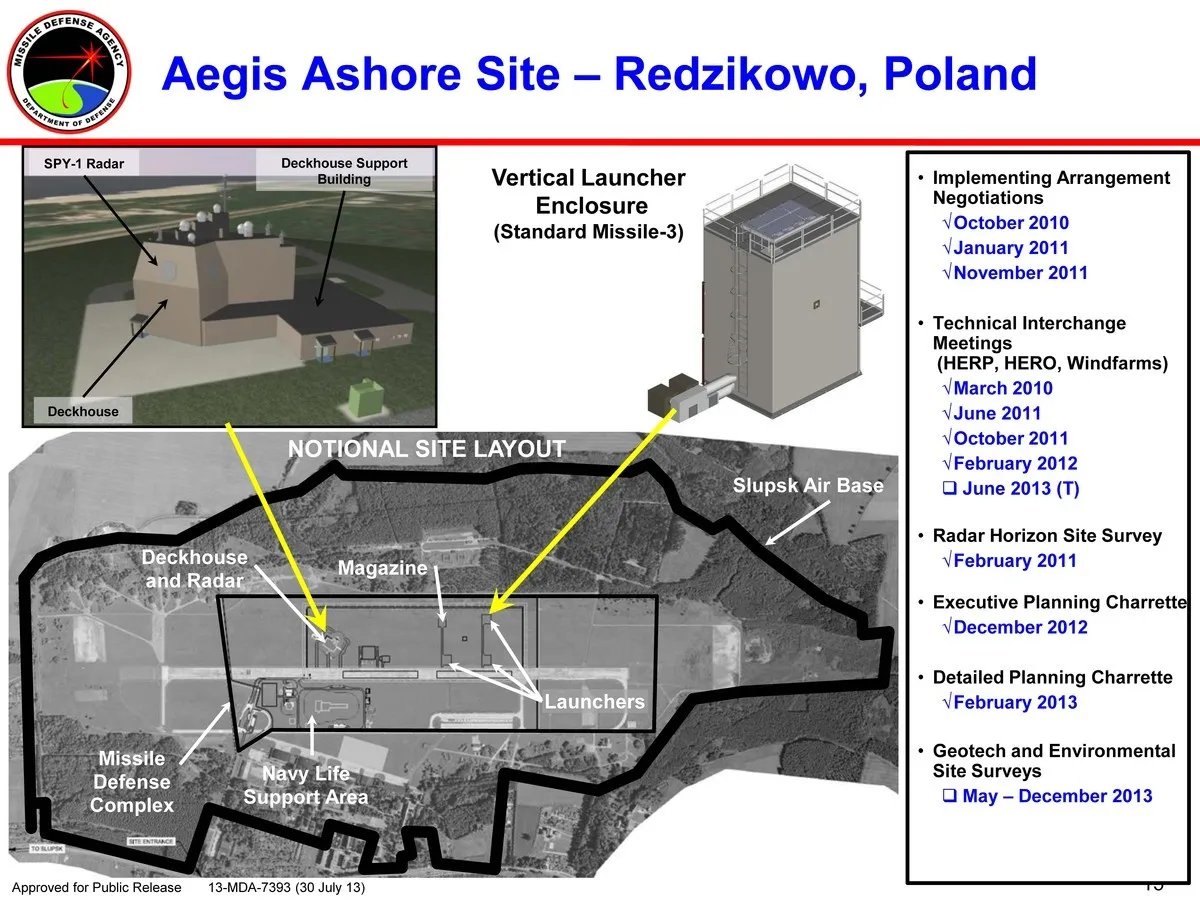
Among those US treaty-violating systems were Aegis Ashore installations capable of tracking and intercepting missiles fired by Russia as part of a retaliatory strike - a key violation of the ABM treaty which would theoretically allow the US to carry out a nuclear or conventional first-strike on Russia while preventing or minimizing any Russian retaliation. The Aegis Ashore system is also capable of ground-launching INF treaty-prohibited Tomahawk cruise missiles (2,500 km) offensively. Aegis Ashore was constructed and brought online in Romania and Poland during the Obama and Biden administrations respectively. 


Also following the US withdrawal from the INF treaty was the development and deployment of the mobile Typhon system capable of ground-launching conventional or nuclear-capable Tomahawk cruise missiles previously prohibited under the INF treaty. The first Typhon systems became operational and plans to deploy it began under the subsequent Biden administration - demonstrating continuity of agenda regardless of whether Democrats or Republicans controlled the US government. 


In addition to the Aegis Ashore and Typhon systems, the US also began work on the Dark Eagle hypersonic ground-launched missile (3,500 km) - another system prohibited under the previous INF treaty. 


There is also the US Precision Strike Missile (PrSM) slated to replace aging and less capable ATAMCS fired by HIMARS and M-270 launchers. PrSM is the closest US-equivalent to the Iskander with PrSM’s current range at 500 km and plans to likewise extend it to 1,000 km in future variants. 


With US-Soviet/Russian treaties abandoned by the US and a growing number of weapon systems being openly developed and deployed by Washington - Russia began rolling out its own comparable systems. 


In addition to the Iskander-1000, Russia has already introduced the Iskander-K (500 km with some variants reaching up to 2,000 km) - a cruise missile launched by the same mobile platforms used to fire Iskander-M ballistic missiles. Ground-launched versions of Russia’s Kalibr cruise missiles (1,500 - 2,500 km) and its hypersonic Zircon missiles (1,000 km) have also been developed and since deployed. 


Most notable among Russia’s rollout of systems to counter US INF treaty-violating weapons is the Oreshnik intermediate-range ballistic missile (3,000-5,500 km) capable of delivering up to 6 multiple independently targetable reentry vehicles (MIRVs) at hypersonic speeds - each of which contain an additional 6 submunitions for a total of 36 projectiles. Its destructive power has already been demonstrated amid the US proxy war on Russia in Ukraine. 


US INF Treaty Destruction Backfiring 


The US withdrawal from the INF treaty (and before that, the ABM treaty) was designed to give the US an advantage over not only Russia by further encircling it with treaty-violating anti-missile and offensive missile systems - but also over China which never signed any arms control treaties with the US. However, the emerging result is a lopsided quantitative and qualitative edge for both Russia and China - saying nothing of their combined capabilities. 


Anduril: “Hyperscaling” the Worst of America’s Military Industrial Complex

August 13, 2026 (NEO - Brian Berletic) - Arms manufacturer “startup” Anduril headed by billionaire Palmer Luckey has quickly morphed into a smaller, more efficient version of legacy American arms manufacturers like Raytheon, Lockheed, and Boeing - a new model for efficiently transferring billions of taxpayer dollars into private industry based on fabricated threats and manipulative promises - all ultimately falling far short of misguided public expectations. 


While Luckey and Anduril have vowed to “hyperscale” production on par or exceeding Russian and Chinese military industrial production with concepts like “software-defined production” - a process Chinese factories have already incorporated within China’s vastly greater industrial base for years - the only thing actually being “hyperscaled” is war propaganda and its resulting war profiteering. 


Doing “Better” Than Legacy US Corporations, Falling Short of Russia and China


While it is true Anduril is developing weapons that may be a fraction of the cost of other weapons manufactured by legacy US arms producers, they fall short of the quality, quantity, and cost-savings of their Russian counterparts - saying nothing of how far they fall short of China’s military industrial capabilities.

And while it can be said an Anduril cruise missile is cheaper than those produced by Raytheon, they fall far short of the range and destruction Raytheon missiles can achieve.

Many of Anduril’s broken promises have been laid bare on the battlefields of America’s many wars of aggression abroad. 


Anduril drones - having promised to revolutionize the battlefield - have already been sent to Ukraine only to be overwhelmed by Russian quantities and quality - along with quickly evolving Russian electronic warfare capabilities transforming Anduril’s drones into yet another overpriced, underperforming capability. 


The Wall Street Journal in a late 2025 article would admit: 


Anduril’s only real battlefield experience—in Ukraine—has been marred by problems as well, including vulnerability to enemy jamming, according to former employees and others familiar with the systems in Ukraine. Some front-line soldiers of Ukraine’s SBU security service, for instance, found that their Altius loitering drones crashed and failed to hit their targets. The drones were so problematic that they stopped using them in 2024 and haven’t fielded them since, according to people familiar with the matter.


Other Anduril products being developed include the Barracuda family of “affordable mass” cruise missiles. While claimed to already be under “mass production,” only about 1,000 are expected to be delivered annually beginning in 2027. 


The Barracuda 500 variant is the longest ranged missile of the family, claiming to have a range of 930 km, a speed of 930 kilometers per hour, but a warhead of only 45 kilograms. 


This missile - yet to be delivered - already falls far short of various "affordable mass” missiles and loitering munitions being employed by Russia on the battlefield including its Geran family of loitering munitions. 


Its propeller driven variants feature longer ranges and heavier warheads than the Barracuda 500. 


The Ukraine War is a US war on Russia

July 16, 2026 (NEO - Brian Berletic) - As the Western media continues shaping narratives depicting a growing divide between the US and Europe regarding the ongoing conflict in Ukraine - a narrative involving an increasingly disinterested and disengaging US with an increasingly desperate and confrontational Europe - it is important to remember precisely how this war was started and why, as well as the material reality shaping its continuation. 


By doing so, it is revealed the only "division" taking place between the US and Europe is a “division of labor,” a phrase literally spoken  by the US Secretary of Defense Pete Hegseth in Brussels in February 2025 delegating the continuation of what is a US proxy war on Russia to Europe while the US redirects resources toward Asia. 


Precisely because the war in Ukraine is a US proxy war on Russia, and the fact that Ukraine’s trained military manpower and territory continue to contract under the pressure of Russia’s strategy of attrition, to continue the war will require introducing additional pools of trained military manpower - and to extend Russia further - to do so along a wider front. 


The military build-up of the Baltic states appears to be at a minimum an attempt to fix Russian forces along their border with Russia. The worst case scenario for Moscow would be for the US to repeat with its Baltic state proxies what it has already done in 2008 with its Georgian proxies and what it has done from 2011 onward with its Ukrainian proxies - attack Russia and its allies militarily, precipitating wider war along a wider front.  


Western European nations, including the so-called “coalition of the willing,” led by France, Germany, and the United Kingdom, have implemented Secretary Hegseth’s directives from February 2025 enthusiastically - directives including to “double down” on arming Ukraine, “spending more on defense,” and convincing the European public of the “threat facing Europe” (meaning Russia). 


With this in mind, it is clear there is not only no split of any kind between the US and its European proxies, Washington’s European proxies have demonstrated unflinching servile obedience even at the cost of placing themselves on the precipice of war with neighboring nuclear-armed Russia themselves.  


The Larger, Long-Engineered War on Russia

Surrounding Russia with a number of geopolitical and economic crises to “extend Russia” with the hope of eventually precipitating a Soviet Union-style collapse, is the subject of numerous US policy papers spanning the entirety of the post-Cold War period. 


There is even a paper published by the RAND Corporation literally titled, “Extending Russia,” listing a number of measures the US has since implemented verbatim before and since its publication in 2019. 


The paper lays out the economic and geopolitical measures the US has since used to both prepare the grounds for this current proxy war, and to both perpetuate and expand it over time. These measures include targeting Russia’s energy exports including specifically targeting pipeline expansion (Nord Stream, since destroyed by the US), the imposition of sanctions on Russia, the destabilization, destruction and/or the political capture of Russia’s allies both along its borders and beyond (including Ukraine, Georgia, Belarus, and Armenia, as well as Syria), and the arming of Ukraine itself following its political capture by Washington in 2014. 


This latter measure, the RAND paper admits, would inevitably invite in wider conflict with Russia - and it did. The paper also admitted the measure would likely end in “disproportionately large Ukrainian casualties, territorial losses, and refugee flows,” and that, “it might even lead Ukraine into a disadvantageous peace.”


The purpose of US policy is not to necessarily “defeat” Russia in Ukraine, or in Georgia, or Armenia, Syria, or in any other particular region - but to create a multitude of crises mounting ever increasing pressure on Russia to create cracks and collapse wherever opportunities allow, and eventually precipitate overall collapse following pressure along a large and growing collection of fronts. 


And this is precisely what the US is doing. 


It doesn’t matter that Ukraine can’t win the current US proxy war against Russia - or that Europe collectively might not be able to either. US objectives are to create a growing conflict that eventually outpaces Russia’s ability to respond and defend itself against. 


Similar strategies have been used against other targets of US “regime change” including Libya, Syria, and Iraq spanning decades before finally and fully succeeding. 


Thus, the measure of Russia’s success is not simply on the battlefield in Ukraine, but its success or failure in defending itself against this much wider campaign of US-driven encroachment - a campaign that has transcended all US presidential administrations since the end of the Cold War without exception and will continue to do so into the foreseeable future. 


US Cements Political Capture of Armenia as it Advances “Extending Russia” Strategy

June 15, 2026 (NEO - Brian Berletic) - The United States continues pursuing its decades-spanning policy of maintaining global primacy by encircling and containing rivals as described in the 1992 New York Times article, “U.S. Strategy Plan Call for Insuring No Rivals Develop.”


As part of this long-standing strategy the US has developed specific plans to encircle and contain key nations including China, Iran, and of course Russia. These plans often overlap - as degrading the power and influence of one targeted nation reduces the combined power and influence of all three as well as the multipolar world order they seek to construct. 


For Russia specifically, the RAND Corporation’s 2019 paper, “Extending Russia: Competing from Advantageous Ground” lays out policy options the US has clearly pursued for years leading up to its publication and ever since. 


These options targeting Russia include those of an economic dimension such as, “hinder petroleum exports,” “reduce natural gas exports and hinder pipeline expansions,” “impose sanctions,” as well as geopolitical measures like “provide lethal aid to Ukraine,” “increase support to the Syrian rebels,” “promote regime change in Belarus,” “exploit tensions in the south Caucasus,” “reduce Russian influence in Central Asia,” and “challenge Russian presence in Moldova.” 


Virtually all of these options have been implemented in one way or another - from the US sending lethal aid to Ukraine the same year this paper was published under the first Trump administration, to the continued arming of terrorists in Syria by the US culminating in the collapse of the Syrian government in 2024, to the physical destruction of the Nord Stream pipelines as well as constantly expanding US-led sanctions and maritime interdiction operations targeting Russian energy exports. 


Exploit Tensions in the South Caucasus: Politically Capturing Armenia 


In light of the recent elections in Armenia (in the south Caucasus region) and the President of the European Commission Ursula Van Der Leyan congratulating Armenian Prime Minister Nikol Pashinyan by exclaiming, “the spirit of the Velvet Revolution you led in 2018 is alive and well,” it appears that once again the US objective of “extending Russia” has been further advanced. 


While many have been tempted to assign Armenia’s pivot away from its traditional Russian partnership to the European Union and NATO to European influence - the US government itself engineered the protests in 2018 Van Der Leyan referenced, with the National Endowment for Democracy (NED) itself admitting in its 2018 annual report that: 


NED’s many grantees in Armenia were in the forefront of the “Velvet Revolution” last spring that swept from office a corrupt and autocratic president who wanted to manipulate the constitution to retain power. In subsequent elections held in December, the party alliance of the new Prime Minister Nikol Pashinyan won 70 percent of the vote, setting the stage for building accountable and effective government ministries, reforming the judicial system, and strengthening the media as a critical watchdog over government performance.


By “corrupt and autocratic” the NED means a government that does not answer to Washington at the expense of its own national interests, and by “accountable and effective ministries,” the NED means accountable to and effective at serving Washington - even at the cost of Armenia’s own interests. 


Organizations involved in the US-engineered “Velvet Revolution” in Armenia and the subsequent cementing of US political capture over the nation include the “Union of Informed Citizens” whose 2021 annual report admitted extensive US government backing and direction continued well after the 2018 protests - as well as Boon TV which is admittedly funded by the NED’s European counterpart, the unimaginatively named “European Endowment for Democracy.”   


Just like with other nations the US has politically captured, Armenia’s “color revolution” and “regime change” were just the beginning. With a client regime in place, the floodgates of foreign interference by the US are opened. 


The NED reported the following year in its 2019 annual report that US government interference shifted from producing desired outcomes during elections to consolidating political control in their aftermath, noting, “since the 2018 revolution in Armenia, NED grantees have shifted their focus from holding a corrupt regime accountable to supporting governance reform.” 


Again - language like “corrupt regime” and “reform” translate into a government unwilling to subordinate itself to US interests and consolidating US control. 


The same 2019 NED annual report notes how “several NED grantees have entered government,” demonstrating how US-engineered protests not only seek to overturn a targeted government, but replace it with a US-prepared and selected client regime. 


NED subsidiaries like the National Democratic Institute (NDI) announced in their own 2020 report regarding Armenia the launching of two programs, “the Intern Program of the National Assembly of Armenia and the Katarine Women’s Political Leadership Program.”


The same report mentioned, “a graduation ceremony for the Institute’s Young Political Leadership Strategy Program.”  

West Says Ukraine is Now “Winning” and Why it is Lying (Again)

May 25, 2026 (NEO - Brian Berletic) - A recent article published in the Kyiv Independent titled, “Is Ukraine starting to win the war again?” tests the maxim that if you need to ask, the answer is probably “no.” 


As the collective Western media has done since 2022, the Kyiv Independent cites “flatlined” Russian territorial gains and expanding drone strikes deep inside Russian territory (the article attributes to Ukraine despite the New York Times admitting such strikes are enabled by the US Central Intelligence Agency and the US military)  - all as evidence of growing Russian weakness and increasing Ukrainian strength. 


A War of Attrition Is Not Measured in Territory or Headlines


In reality - and even as the article itself admits - the war is not one of territorial gains or headline-grabbing drone strikes, but one of attrition. 


At one point the article even admits, “the upper hand will be gained by the side in whose favor the long attritional fight is running.” 


In any war of attrition, the primary factors lending leverage to one side over another is military industrial production and the ability to maintain or expand trained manpower. By implication this also means the ability to maintain the economic, social, and political stability required to support these enabling factors.  


Here the Kyiv Independent concedes Russia wins out big in both categories, admitting “Russia continues to be able to steadily recruit between 30-35,000 new soldiers per month, enabling Moscow to sustain its losses on the battlefield,” and that, “Moscow aims to produce 7.3 million FPVs in 2026.” 


While the Kyiv Independent claims the quality of those 30,000-35,000 Russian troops recruited each month are low, poorly trained, and poorly equipped in the field, it avoids discussing Ukraine’s recruitment struggles. This includes the fact that - unlike Russia’s recruited manpower who voluntarily sign contracts - much of Ukraine’s manpower is pressed into service - sometimes literally being beaten into submission and dragged to the frontline. 


Regarding drone production, other Ukraine-based sources put Ukraine’s drone output somewhere around 4 million per year, or about half of Russia’s production numbers according to the Kyiv Independent. 


It should be pointed out that in addition to Russia outproducing Ukraine (and in reality, Ukraine’s American and European sponsors) in terms of drones - an area of supposed “Ukrainian” strength - Russia continues outproducing Ukraine and its Western sponsors in all other categories of conventional military power as well, from artillery shells and precision-guided missiles, to armored vehicles and anti-aircraft systems. 


Imagining Victory 


The article repeats recent talking points circulating throughout Wall Street-funded Washington-based policy think tanks regarding the cutting off of Russian forces from use of US-based SpaceX’s Starlink satellite communication network as well as high-profile drone strikes deep inside Russia threatening to risk what Western pundits call  “breaking the key social contract at the heart of Putin's rule,” - that is - the illusion of peace at home while Russia wages war abroad. 


However, none of these claims - whether real or imagined - impact the fundamental factors that either win or lose a war of attrition. 


Drone strikes on Russia have targeted energy production, storage, and export facilities, manufacturing centers, and other infrastructure critical for both Russia’s military and economic viability. While these strikes have caused damage, it has not been at a pace greater than Russia’s capacity to repair and/or adapt to the strikes. 


The drone strikes have raised the costs for Russia of the ongoing US proxy war, but have not changed the overall math of attrition that favors Russia owed to its structural advantages. And while this might seem like a fundamental failure for the US - it is actually precisely what US policymakers set out to do as laid out in policy papers stretching back years before the Russian operation began in 2022. 


US Seeks to “Extend” Russia, Not Necessarily Defeat it in Ukraine  


What the drone strikes also achieve is the creation of a psychological effect - not on Russia’s leadership or population - but on the Ukrainian population and the wider Western public - especially the European public. 


The US War for Energy Dominance Leads to Dominance Over Europe and Asia

May 3, 2026 (NEO - Brian Berletic) - The US war on Iran - at face value - appears to be a catastrophic tactical and strategic US failure demonstrating the limits of its military power and further exposing the limits of its military industrial capacity. 


However, just as with its still-ongoing proxy war on Russia in Ukraine, its inability to overwhelm targeted nations with outright military power distracts away from the many ways the US is still advancing its geopolitical objectives by other means. 


In Ukraine, the US has categorically failed in defeating Russian forces through its support of its Ukrainian proxies. However, it has used the war to lock Russia into an expensive, prolonged, high-intensity conflict that has demonstrably compromised Russian interests beyond Europe - especially regarding the 2024 collapse of Syria.


The war has also succeeded in cutting Europe off from cheap, reliable, and plentiful Russian energy and is placing Europe under increasing, and likely irreversible energy dependence on the United States. 


This energy dependence on the US obviously benefits US-based energy corporations financially but also enhances Washington’s strategic leverage or even outright control over Europe. This control is being used to successfully create a united front across Europe against Russia. 


In a similar manner - the US is using its war on Iran to strangle energy exports from the entire Middle East to Asia to decouple Asia from cheap, reliable, plentiful gas and oil and place it under US energy dependence, thus providing the US strategic leverage over Asia to create a similar united front against China. 


Decoupling Europe from Russian Energy Through War Was Planned 


In the 2019 RAND Corporation paper titled, “Extending Russia: Competing from Advantageous Ground,” a number of “economic” and “geopolitical” measures were laid out, designed to “extend” Russia and possibly precipitate a Soviet Union-style collapse like that which ended the Cold War.


Under “economic measures,” the paper lists “hinder petroleum exports,” “reduce natural gas exports and hinder pipeline expansions,” “impose sanctions,” and “enhance Russian brain drain.”   


The paper first argues that one of the main methods of implementing these measures is to expand US oil and gas production and its export to Europe. 


However, under a section titled, “likelihood of success," the paper explicitly admits:


“Reducing European peacetime consumption of Russian gas has a medium to low likelihood of success. Diversifying away from Russia is expensive, and projects might be difficult to accomplish.”  


It should be remembered that at the time, the US was already investing in LNG export facilities and even exporting LNG targeting markets in Europe - at a time US policymakers admitted it made no financial or economic sense to do so. 


However, the paper was far from finished. Under “geopolitical measures,” the paper lists first and foremost, “provide lethal aid to Ukraine.” 


The paper admits that: 


“Expanding U.S. assistance to Ukraine, including lethal military assistance, would likely increase the costs to Russia, in both blood and treasure, of holding the Donbass region. More Russian aid to the separatists and an additional Russian troop presence would likely be required, leading to larger expenditures, equipment losses, and Russian casualties. The latter could become quite controversial at home, as it did when the Soviets invaded Afghanistan.”


In other words, by providing lethal aid to Ukraine - which the US began doing under the first Trump administration - the US would be knowingly attempting to provoke a war with Russia in Ukraine. 


Not only would the resulting war generate high costs for Russia militarily, it would also obviously transform the chief obstacle to reducing/hindering Russian oil/gas exports and expanding US LNG exports - that chief obstacle being “peacetime” - into unending wartime.